


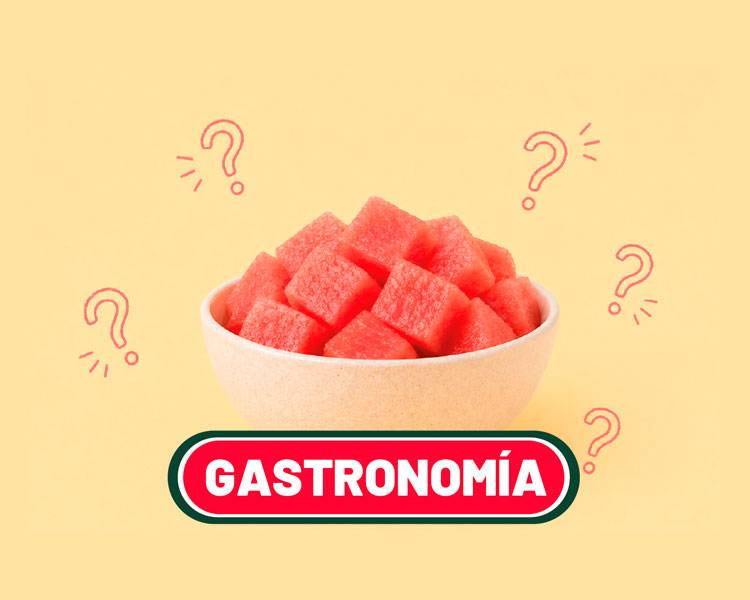
This fruit raises a very common question: is watermelon a fruit or a vegetable? And although many people automatically answer that it is a fruit, the reality is more nuanced than it seems.
This is because watermelon shares characteristics with both fruits and certain vegetables. It is grown in a similar way to certain vegetables, features in savoury recipes and belongs to a rather unusual family.
But then, what is it really? We’ll tell you.
Is a watermelon a fruit or a vegetable? The simple answer
Watermelon is a fruit. From a botanical point of view, it meets all the criteria that define a fruit.
The problem is that many people associate the word ‘fruit’ solely with sweet foods that grow on trees. And of course, when they see a watermelon growing on the ground, in vegetable gardens, much like other vegetables, that’s when the confusion sets in. But botanically speaking, the watermelon is a fruit.
Why is watermelon a fruit?
There are several clear reasons why watermelon is considered a fruit.
Grown from the flower
One of the main criteria for classifying a food as a fruit is that it develops from the plant’s flower.
The watermelon develops after the watermelon plant has flowered, just as is the case with other fruits such as melons, apples and tomatoes.
This is a key point.
Contains seeds
Another important point is that watermelons contain seeds inside.
The purpose of fruit is to protect and disperse the plant’s seeds, and the watermelon fulfils that role perfectly.
Even seedless varieties originally come from plants developed using this very same process.
It is the fruit of the plant
A watermelon is the fruit produced by the watermelon plant following pollination of the flower. By botanical definition, this makes it a fruit.
Whether you eat it as a dessert, in salads or in savoury dishes… it’s still a fruit.
Why do so many people think it’s a vegetable?
Although watermelon is a fruit, it has several characteristics that lead many people to regard it as a vegetable.
It is grown as a vegetable
Watermelons are grown in vegetable gardens and fields in much the same way as foods such as courgettes, cucumbers and pumpkins.
It does not grow on trees or bushes, but on creeping plants that take up quite a lot of space on the ground.
Visually and from an agricultural perspective, this means that many people tend to view it more as a vegetable.
It belongs to the cucumber and squash family
This is probably the most surprising fact.
Watermelon belongs to the Cucurbitaceae family, the same family that includes:
- Cucumber
- Pumpkin
- Melon
- Courgette
That is why it shares certain characteristics with very common vegetables.
But belonging to that family does not change its botanical classification as a fruit.
It is used in savoury recipes
Another reason why many people are unsure is that this fruit is no longer used solely in desserts; there is now a wide variety of savoury recipes featuring watermelon.
Nowadays, it is very common to see it in:
- Salads
- Appetisers
- Dishes featuring feta cheese
- Recipes with ham
- Gourmet dishes
When a food appears in savoury dishes, many people automatically stop thinking of it as a fruit. But that doesn’t change what it really is.
What kind of fruit is a watermelon?
Watermelon is a juicy, refreshing fruit belonging to the cucurbit family, a type of berry with a thick rind characteristic of the cucurbitaceae family.
Yes, technically speaking, a watermelon can also be considered a giant berry.
It also stands out for:
- Its high water content
- Its sweet taste
- Su bajo aporte calórico
- Its refreshing properties
Por eso es una de las frutas más consumidas durante el verano.
Entonces, si te preguntabas si la sandía es fruta o verdura, la respuesta es clara: la sandía es una fruta. La confusión aparece porque se cultiva como muchas hortalizas y cada vez se utiliza más en recetas saladas.
But from a botanical point of view, it perfectly meets the criteria for a fruit: it develops from a flower, contains seeds and is the fruit of the plant.